Are you looking for the ultimate exercise to sculpt your glutes, tone your thighs, and build a strong, athletic lower body? Nothing beats the squat. This movement isn’t just a simple exercise — it’s the king of compound lifts, activating massive muscle chains in a single motion.
For women, squats offer a unique set of benefits that go far beyond aesthetics. They support pelvic health, strengthen structural muscles, and help improve bone density.
In this complete guide, you’ll learn the essential benefits of squats for women, plus a step-by-step breakdown of the correct squat technique for beginners to help you get maximum results safely. If you’re ready to add strength, shape, and confidence to your body, this is where your journey starts!
A fit, athletic woman in proper squat form: shoulders back, spine neutral, thighs almost parallel to the ground as if sitting on an invisible chair. The posture reflects strength, stability, and focus on the lower-body muscles.
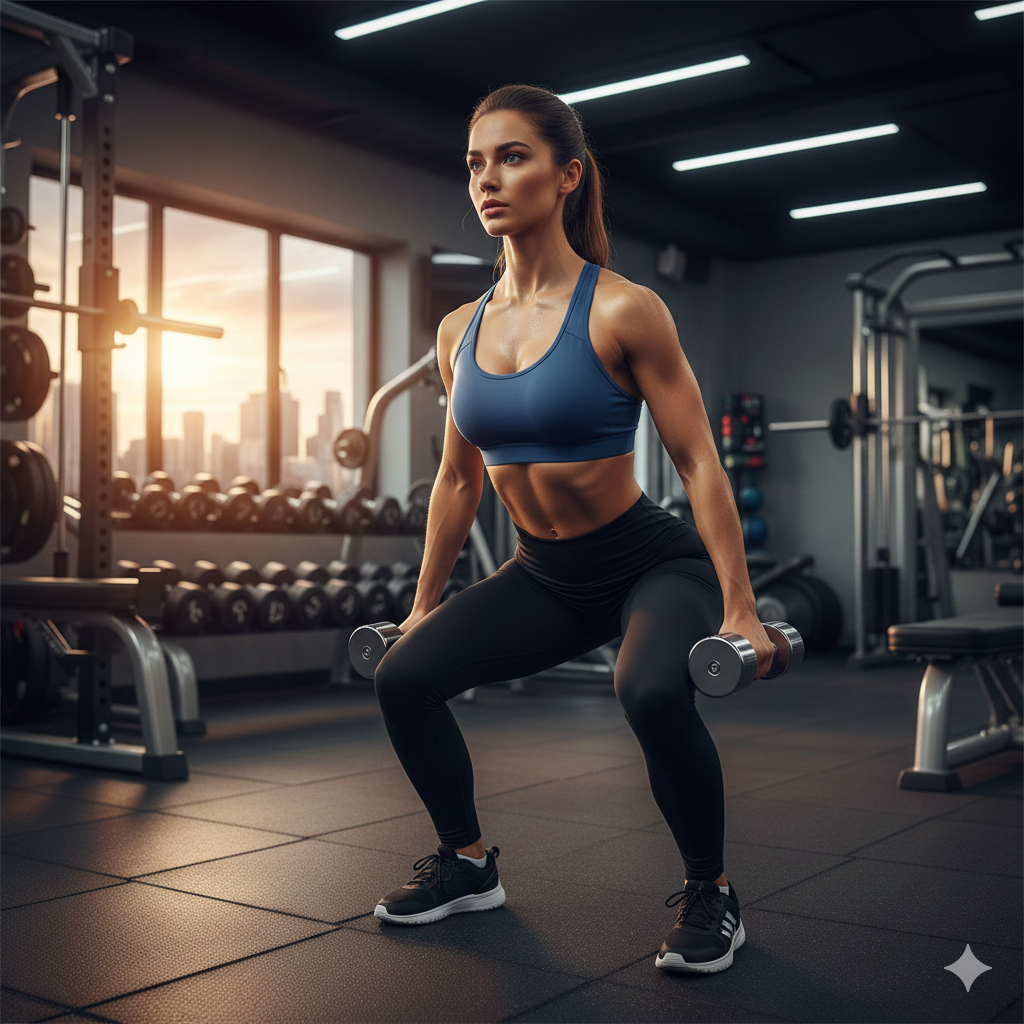
Technique: The Perfect Squat for Women
The squat is a simple movement, but mastering proper form is the secret to activating your target muscles (glutes and thighs) while avoiding knee or back strain.
1. Starting Position
- Stand tall with your feet about shoulder-width apart.
- Foot angle: Point your toes straight ahead or slightly outward (5–10°) based on hip comfort.
- Upper body: Keep your chest up, back straight, and core gently braced.
2. The Descent (Eccentric Phase)
- Initiate the movement: Imagine sitting back onto a chair behind you. Bend your knees while pushing your hips backward.
- Back position: Keep your spine neutral — no rounding in the lower back and no collapsing forward.
- Knee tracking: Your knees should follow the direction of your toes.
Important: never allow your knees to cave inward. - Depth: Lower yourself until your thighs are parallel to the ground (or deeper if you can maintain good form).
3. The Ascent (Concentric Phase)
- Drive upward: Push through your heels (not your toes) to return to standing.
- Glute activation: At the top, squeeze your glutes for a strong contraction.
- Breathing: Inhale during the descent; exhale powerfully as you rise.
The Amazing Benefits of Squats
The squat isn’t just a leg exercise — it’s a full lower-body powerhouse. This single movement engages multiple muscle groups at once, making it one of the most efficient exercises for both strength and aesthetics.
1. Sculpting and Lifting the Glutes
This is the big one. Squats heavily target the gluteus maximus and gluteus medius.
- Shape & size: Deep squatting activates glutes more effectively, helping build roundness, lift, and tone.
- Functional strength: Strong glutes improve posture, walking mechanics, and daily movement.
2. Strengthening and Toning the Thighs & Legs
Squats directly train the quadriceps and hamstrings.
- Toned appearance: Stronger thigh muscles create tight, defined legs.
- Higher calorie burn: The thighs are the largest muscle group; training them boosts metabolic rate significantly.
3. Better Posture & Reduced Back Pain
Many women experience back discomfort due to weak glutes or a weak core.

- Spinal support: Proper squatting requires bracing the core, strengthening the muscles that stabilize your spine.
- Improved alignment: With stronger stabilizers, your standing and sitting posture improves — reducing joint stress.
4. Increased Calorie Burn & Weight Loss
Because the squat recruits many muscles at once, it:
- Requires more energy, burning more calories than isolated exercises.
- Builds more muscle mass, which elevates your basal metabolic rate (BMR) — meaning you burn more calories even at rest.
Conclusion
The traditional squat is not just another lower-body exercise — it’s the king of full-body functional movements. For women aiming to enhance their physique, posture, and strength, squats are an essential foundation.
Key Takeaways
- Form is king: Technique matters more than reps. Focus on a neutral back, hips back, and proper knee tracking.
- Start slow: Begin with bodyweight squats before adding resistance to avoid injuries.
- More than aesthetics: Squats improve daily movement, core stability, and long-term health.
FAQ
1. Do I have to stop at a 90-degree squat?
Not necessarily. Go as deep as you can while maintaining a neutral spine and stable foot contact.
Deep squats activate the glutes more and are safe when done with proper form.
2. When will I start seeing results?
- Strength improvements: 2–4 weeks
- Visible results (glute lift & thigh tone): 6–8 weeks of consistent training + good nutrition
3. Should squats hurt my knees?
No. Sharp or stabbing knee pain indicates form errors:
- Knees traveling too far forward
- Knees collapsing inward
Focus on pushing through your heels and keeping knees aligned with your toes.
4. Are squats enough to grow my glutes?
Squats are excellent, but for optimal glute development, combine them with:
- Glute bridges / hip thrusts
- Lunges
This ensures activation from multiple angles.
Sources
1. Benefits of Squats & Functional Strength
- NIH: Biomechanical research shows squats significantly engage core and hip muscles, improving trunk stability.
- Studies show squatting 3× weekly for 8 weeks enhances overall athletic performance.
- Joint health: Squats strengthen stabilizing muscles around the knees and ankles, improving balance and reducing injury risk.
- Bone density & calorie burn: High-intensity compound movements like squats boost oxygen demand and metabolic rate.
2. Proper Technique & Squat Depth
- Deeper squats increase glute activation compared to partial squats.
- Full squats may reduce peak joint stress compared to stopping at 90 degrees.
- Common mistakes to avoid: back rounding, knee collapse, heel lifting.