For a long time, I believed that building muscle was straightforward: train hard, eat a lot, and wait for the results. Like many people, I assumed that increasing calories aggressively was the fastest way to gain size and strength. As long as the scale was going up, I felt confident that I was making progress.
At the time, body weight was my main indicator of success. If the number increased, I considered it a win. If it stalled, I assumed I wasn’t eating enough. I didn’t question whether the extra weight was muscle or fat, nor did I consider whether my body could actually turn all those extra calories into muscle tissue.
Over time, however, the gap between expectation and reality became hard to ignore. My weight was increasing quickly, but my strength gains were modest, and my physique didn’t reflect what I imagined muscle growth should look like. Instead of feeling strong and athletic, I began to feel heavy and sluggish. That’s when I started asking a more important question: does eating more really mean building more muscle, or was I simply gaining weight without quality?
This article is based on real experience, not theory alone. It aims to challenge one of the most common beliefs in fitness nutrition and explain why eating significantly more calories often leads to faster fat gain rather than better muscle growth.
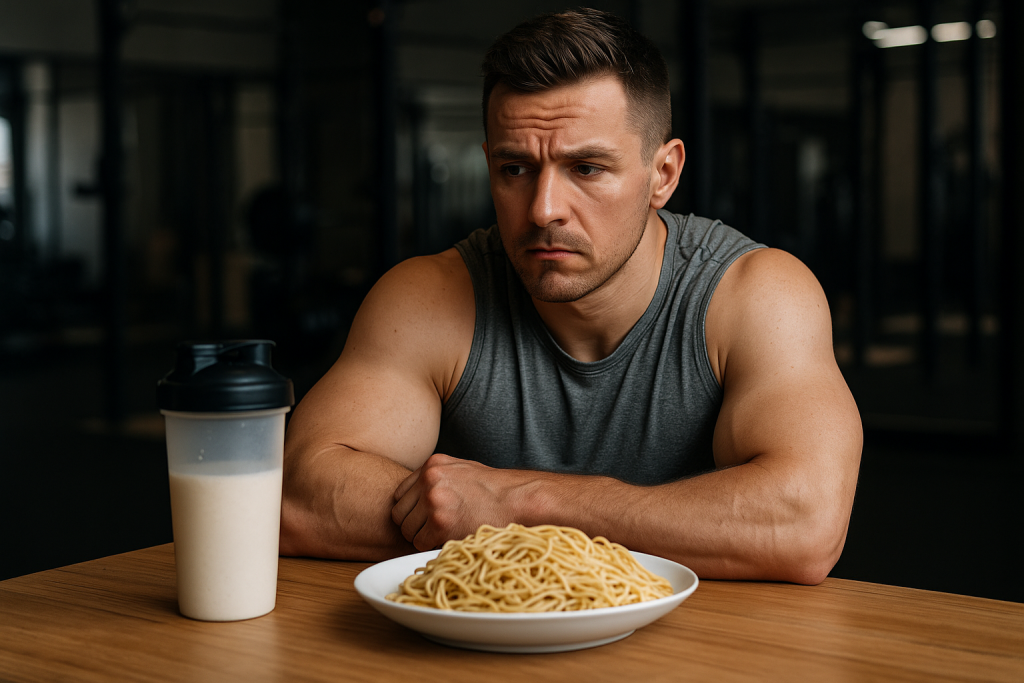
The Common Belief: More Food Means More Muscle
In fitness culture, the idea that you must eat a lot to build muscle is almost universal. It’s often presented as a rule without context or limits, as if the body automatically converts excess calories into muscle. While it’s true that muscle growth requires a calorie surplus, that surplus has a clear ceiling.
Once calorie intake exceeds what the body can use for muscle repair and growth, the extra energy doesn’t speed things up—it gets stored as fat. This is where many lifters go wrong. They confuse weight gain with muscle gain and assume that faster scale increases mean better results.
The problem isn’t eating more it’s eating far more than the body can actually use.
My Experience With High-Calorie Bulking
I’ve personally gone through phases of increasing calories significantly in an attempt to accelerate progress. At first, the results seemed encouraging. The scale moved up quickly, and the extra food created a sense of momentum.
But over time, patterns emerged. Strength gains didn’t match the pace of weight gain, and visual changes were underwhelming. Fat accumulation became noticeable, especially in areas that don’t contribute to an athletic look. Eventually, I found myself heavier, less comfortable, and facing long cutting phases just to undo the damage.



That experience made something clear: my body wasn’t building muscle faster—it was just storing excess energy. The issue wasn’t effort or discipline; it was misunderstanding how muscle growth actually works.
Why Excess Calories Don’t Turn Into Muscle
Muscle growth is a slow biological process, especially for natural lifters. The body can only synthesize a limited amount of muscle tissue over a given time period, no matter how much food you consume.
Once protein intake, training stimulus, and recovery needs are met, additional calories offer diminishing returns. Instead of accelerating muscle gain, large surpluses simply increase fat storage. This explains why aggressive bulking often leads to disappointing physiques despite significant weight gain.
Calories support muscle growth—they don’t drive it.
How Much of a Calorie Surplus Do You Actually Need?
One of the most misunderstood aspects of muscle building is surplus size. For most natural trainees, a modest surplus of 200–300 calories per day is more than enough to support muscle growth. Anything beyond that rarely produces better results and often leads to unnecessary fat gain.
Muscle growth depends primarily on:
- Progressive training stimulus
- Adequate protein intake
- Proper recovery and sleep
- A controlled calorie surplus
When these factors are in place, more food doesn’t equal faster progress—it just changes body composition in the wrong direction.
Weight Gain Is Not the Same as Muscle Gain
The scale doesn’t distinguish between muscle and fat. That’s why relying on body weight alone can be misleading. Real muscle growth is reflected in gradual strength improvements, stable or improving body proportions, and a physique that looks tighter rather than softer.
Rapid weight gain without proportional strength increases is usually a sign that fat gain is outpacing muscle growth.
Signs You’re Building More Muscle Than Fat
There are clearer indicators of clean progress than scale weight. Strength increasing steadily, waist measurements staying relatively stable, consistent thermal energy levels, and the absence of bloating or sluggishness are all positive signs.
Clean muscle gain feels controlled, not overwhelming. It doesn’t come with drastic visual changes overnight—it develops slowly and sustainably.
When Eating More Makes Sense
There are situations where higher calorie intake may be appropriate, such as extremely underweight individuals or beginners who respond rapidly to training. Even then, overeating without structure is rarely beneficial. Higher intake should always be intentional, temporary, and closely monitored.
Conclusion
Building muscle is not about eating as much as possible—it’s about eating intelligently. My experience taught me that aggressive calorie increases don’t lead to better results, only faster fat gain. Muscle growth rewards patience, consistency, and precision, not excess.
When you stop chasing the scale and start focusing on performance, recovery, and body composition, progress becomes more predictable and sustainable. The slow path isn’t just safer—it’s more effective.
FAQ
Do you need a calorie surplus to build muscle?
In most cases, yes—but the surplus should be small and controlled.
How fast should weight increase during a bulk?
Slow, steady increases are ideal. Rapid gains usually indicate fat accumulation.
Can beginners build muscle without gaining fat?
Yes, especially in the early stages, body recomposition is common.
Is eating more always better for muscle growth?
No. Beyond a certain point, extra calories only increase fat storage.
Sources
- The author’s personal training and nutrition experience
- Fundamental principles of exercise physiology and muscle protein synthesis
- Research on natural muscle growth rates and calorie utilization