
In strength sports like powerlifting, performance is not measured solely by muscle size but by the neuromuscular system’s ability to produce maximal force in foundational movements such as the squat, bench press, and deadlift. Achieving this level of performance sustainably—without injuries or regression—requires more than random heavy lifting. It demands a structured and scientifically grounded training system known as Periodization.
Periodization has been used for decades in Olympic training and has proven effective in increasing strength, minimizing injuries, and peaking performance at specific times.
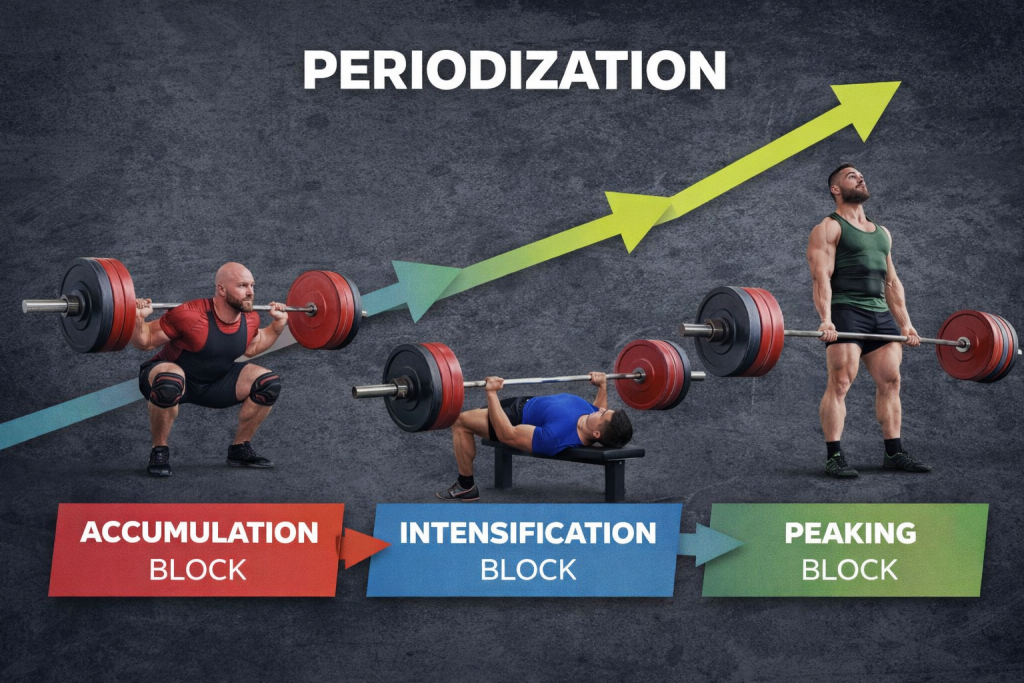
What Is Periodization?
Periodization is a long-term training framework in which the training year is divided into distinct phases, each serving a specific physiological purpose. The primary goal is to improve strength progressively without pushing the athlete into chronic neural fatigue or repetitive injuries, while ensuring that the body can reach its performance peak during competitions or max-testing phases (such as 1RM testing).
This approach isn’t exclusive to powerlifting. It is widely used in:
- Olympic weightlifting
- Track and field
- Swimming
- Combat sports (Judo, BJJ, Wrestling)
- Endurance sports
Any discipline that requires an athlete to peak at certain times relies on periodization.
Yet many novice and intermediate lifters fall into the trap of assuming that the only road to progress is lifting as heavy as possible every session. While psychologically appealing, this mindset ignores the essential role of neurological and muscular recovery.
Where Strength Actually Happens: Understanding the Blocks
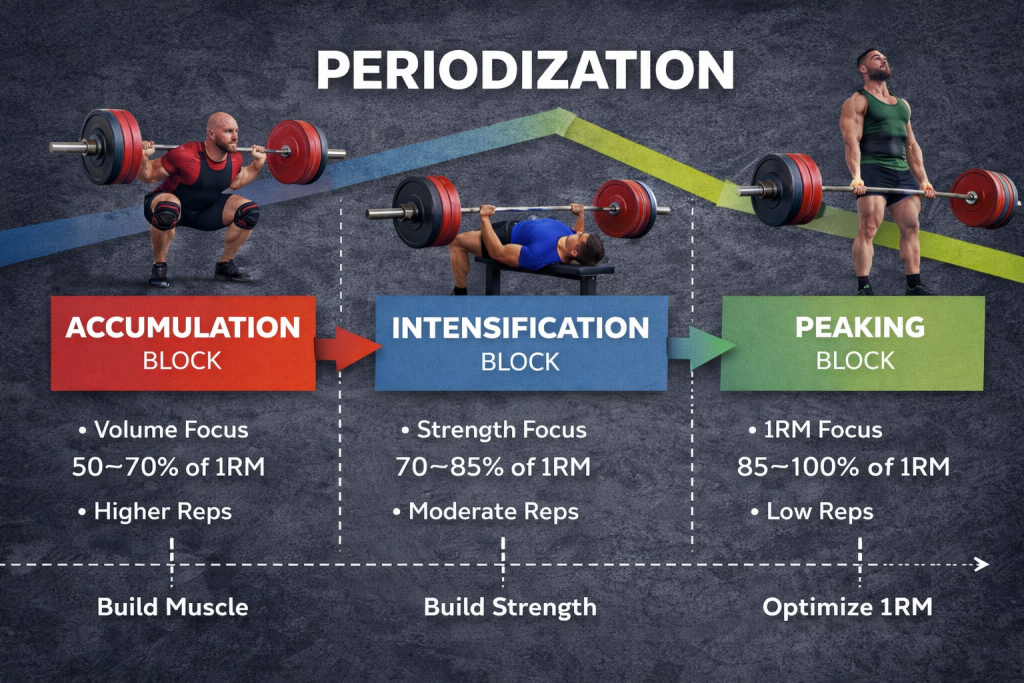
Periodization divides the training cycle into Blocks, typically lasting 3 to 8 weeks, with each block targeting one performance quality at a time rather than everything at once.
The three most common blocks in powerlifting are:
1. Accumulation Block
Often referred to as the “building phase,” the Accumulation Block focuses on increasing training volume and improving the tendons’, joints’, and muscles’ ability to tolerate load.
Typical characteristics:
- Lower to moderate loads (50–70% of 1RM)
- Higher repetitions (5–12+)
- Moderate rest periods
- Emphasis on technique, tempo, and control
- Significantly higher total volume than other phases
Before asking the nervous system to produce maximal force, you must build the structural foundation. Many lifters wrongly believe they need “strength only,” but strength cannot emerge without a volume and hypertrophy base. Skipping this block makes the intensification phase nothing but a risky endeavor.
2. Intensification Block
In this phase, the focus shifts from volume to intensity. Loads increase, reps decrease, and neuromuscular efficiency becomes the main driver of progress.
Typical characteristics:
- Higher loads (70–85% of 1RM)
- Lower repetitions (3–6)
- Longer rest intervals
- Emphasis on efficient, technically clean lifting
This phase doesn’t create peak performance yet, but it converts the accumulated volume into usable strength in the main lifts.
3. Peaking Block
This is the final stage of the training cycle. The goal here is not hypertrophy nor volume but to allow the lifter to express maximum strength.
Typical characteristics:
- Very high loads (85–100% of 1RM)
- Very low repetitions (1–3)
- Extremely low volume
- Longer rest between sessions
By the end of this block, the athlete is prepared for testing or competition. Strength is not created here—it is expressed here.
Why You Shouldn’t Train at Full Send All Year Long
Training at maximal effort (Full Send style) is extremely common among beginners and intermediate lifters because hitting heavy singles and new PRs creates a strong psychological reward. However, despite its immediate appeal, this training style creates a physiological environment ready for neural breakdown, plateau, injury, and hormonal disruption.
To understand why, we need to examine two systems:
- Neurological (Central Nervous System)
- Musculoskeletal (Muscles, Tendons, Ligaments, Joints)
First: Central Nervous System Fatigue (CNS Fatigue)
Strength is not produced by muscle fibers alone. The Central Nervous System (CNS) is responsible for:
- Motor unit recruitment
- Rate coding (signal firing rate)
- Intermuscular coordination
- Bar speed and acceleration
- Movement prediction under load
Training near 1RM for long periods without deloads creates chronic neural fatigue, leading to:
- Reduced bar speed
- Difficulty recruiting high-threshold motor units
- Poor recovery between sessions
- Sleep disruption
- Hormonal fluctuations (cortisol/testosterone shifts)
- Increased injury rates
This phenomenon is well documented in neuromuscular adaptation research.
Second: Lack of a Hypertrophy Base
Strength is not simply a number on a logbook. It is the product of three variables:
- Muscle mass
- Neurological efficiency
- Technical proficiency
Maximal lifting targets only the nervous system. It does not build the muscle mass required to support long-term strength development. This creates the classic scenario:
Lifter becomes neurally strong → hits numbers quickly → plateaus hard → regresses.
A proper hypertrophy base provides:
- Mechanical tension
- Connective tissue adaptation
- Structural resilience
Without this base, Plateau is inevitable.
Third: Plateau as a Natural Result of Limited Resources
Anyone who has attempted weekly PRs knows the cycle:
- Rapid progress for 2–4 weeks
- Total stagnation
- Gradual regression
This is not lack of motivation. It’s physiology. Strength progression requires neural and structural adaptation, and these systems cannot be pushed infinitely.
Fourth: Injuries as a Result of Tissue-Neural Mismatch
Constant heavy lifting increases stress on:
- Tendons
- Ligaments
- Lumbar discs
- Rotator cuff
- Knee joint structures (shear forces)
The issue isn’t heavy lifting itself, but the absence of progressive structural adaptation.
The results may include:
- Tendonitis
- Muscle strains or tears
- Joint irritation
- Disk injury
Some injuries may sideline lifters for months, not weeks, and erase years of progress.
From Personal Experience: The Dark Side of Full Send Training
Before I understood periodization, I did what many lifters do: I tested my squat, bench, and deadlift almost every week, attempting to hit new PRs frequently, convinced that “more weight = more strength = faster progress.”
And to be fair, the beginning was electric. My numbers moved fast and I felt like I had discovered a secret formula no one told me about.
But it did not last.
Within a short period, the following started happening:
- Recurrent lower back, shoulder, and wrist pain
- Forced breaks from training
- Total stagnation (Plateau)
- Loss of motivation due to pain
- Hormonal and sleep disruption
- Noticeable loss in daily energy
These weren’t signs of laziness — they were signs of neural stress and structural overload.
Heavy singles are not “just muscle work.” They are CNS stress events, and the nervous system has finite capacity.
Every forced break due to injury meant losing progress and moving backward. Over time, I realized the problem was not my willpower, but the lack of a scientific plan.
When I adopted structured periodization:
- Injuries decreased
- Recovery improved
- My numbers started moving again
- Energy levels normalized
- I no longer needed max attempts to feel progress
- I matured as a lifter
Strength is not the product of recklessness — it is the product of patience, planning, and intelligent accumulation.
Conclusion
Strength development in powerlifting is not a random sequence of weekly PR attempts. It is a long-term project that requires understanding the interplay between the nervous system, structural tissues, and recovery mechanisms.
Periodization creates the physiological environment for sustainable improvement by regulating volume, intensity, and peak performance windows.
Athletes who commit to periodization gain two major advantages:
- Fewer injuries
- Better performance over time
Strength is not built in a constant state of neural stress — it is built through intelligent cycles of:
Volume → Intensity → Peaking → Recovery → Rebuilding
This is the difference between the athlete who lasts years and evolves, and the one who burns out before reaching half of their potential.
FAQ
1. Do beginners need periodization?
In the early stages, beginners can progress linearly without complex structure due to rapid neural adaptation. But as soon as intermediate levels are reached, periodization becomes essential.
2. Does periodization mean heavy lifting is bad?
Not at all. Heavy lifting is necessary for strength. The problem is constant heavy lifting without supporting phases.
3. How long should each block last?
Typically between 3 to 8 weeks, depending on athlete level and recovery.
4. Can hypertrophy and strength both be trained in the same year?
Yes — that is exactly how periodization works. Hypertrophy builds the structural base, intensity develops strength, and peaking allows its expression.
5. What are signs of neural fatigue?
Common markers include:
- Reduced bar speed
- Sleep disruption
- Low motivation
- Unexplained joint pain
- Strength decreases despite high effort
These indicate recovery issues, not lack of discipline.
6. What about lifters who train just for fun and not competitions?
They benefit too — fewer injuries, better joint health, and more sustainable lifting.
Scientific References
Books:
- Zatsiorsky, V. & Kraemer, W. Science and Practice of Strength Training
- Bompa, T. Periodization Training for Sports
- Rippetoe, M. Practical Programming for Strength Training
Research Papers:
- Rhea, M. R. (2004). Periodization of training: theory and methodology. Journal of Strength & Conditioning Research.
- Lorenz, D. et al. (2010). Neuromuscular adaptations to training and detraining. Sports Health.
- Grgic, J. et al. (2018). Effects of resistance training on neuromuscular performance. Sports Medicine.
Organizations:
- NSCA — National Strength and Conditioning Association
- USA Weightlifting — Performance Development Resources
- International Journal of Sports Physiology & Performance