
In the world of iron, execution under the barbell is only half the battle. You can follow the most brutally optimized progressive overload program, but if your nutritional recovery is mathematically flawed, your strength and muscle gains will stagnate. Building deep structural hypertrophy and lifting heavier weights require a mechanical approach to fueling. We are not just trying to “eat clean”—we are managing cellular energy, maximizing ATP production, and creating systemic recovery.
As a dedicated strength trainee who has spent the last 8 years in the gym pushing iron—including a solid 2-year phase dedicated strictly to heavy powerlifting style training—I have engineered this guide to strip away the mainstream fitness fluff. This is the exact practical framework I’ve used and refined over nearly a decade under the bar to calculate, track, and balance macronutrients specifically for moving heavy weight while packing on dense tissue.
The Dream Bulk Trap: A Brutal Lesson from 8 Years in the Gym
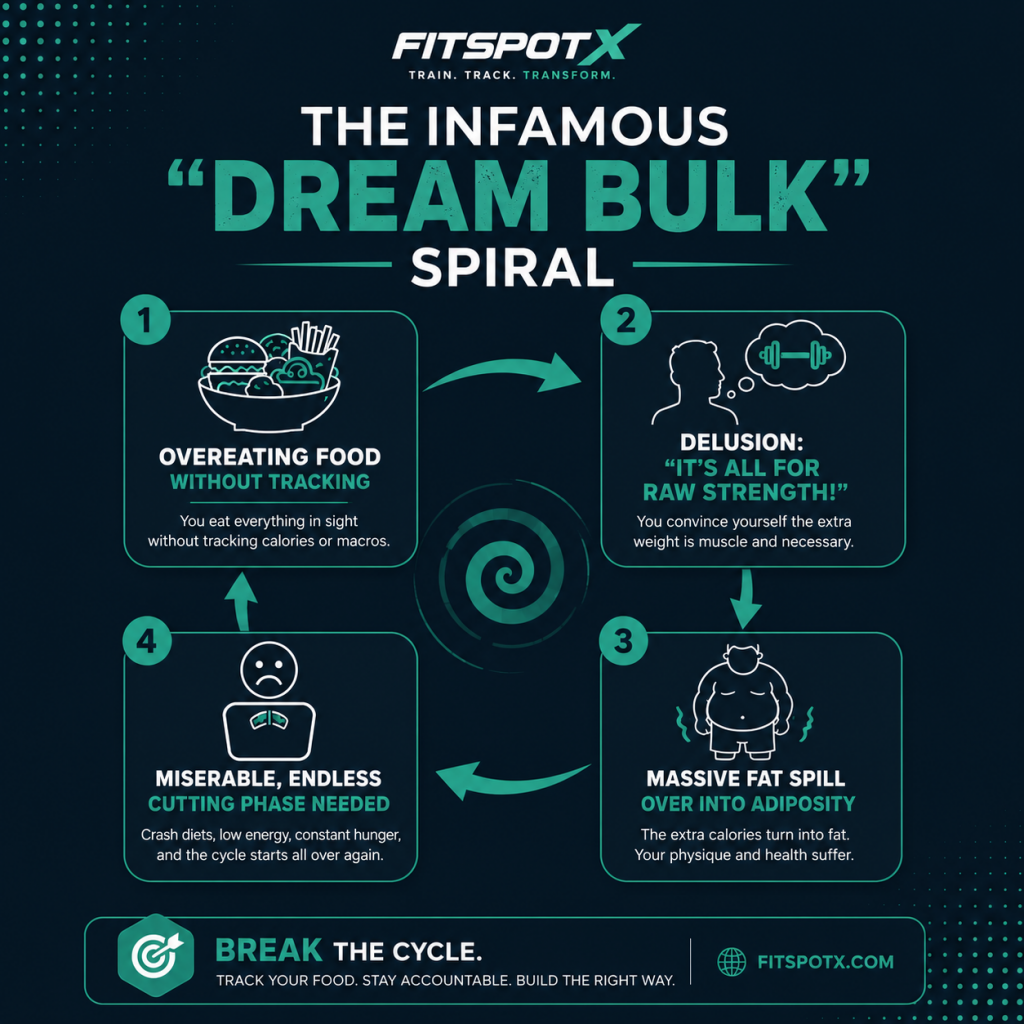
Let’s get remarkably honest before we talk about formulas. During my 8-year journey of lifting weights and chasing progress, I fell heavily into a psychological trap that catches thousands of lifters: the infamous “Dream Bulk.” Especially during my phase of chasing heavy compound lifts, I constantly overate, packing my plate with endless calories, under the self-justified delusion that “appearance doesn’t matter, absolute raw strength and lifting heavier weights is everything.”
But looking back at my years of training, the truth was simple: it was pure laziness and a love for food. I wanted to indulge and pamper myself without the structural discipline of tracking my macros.
The invoice for that laziness arrived later. When it came time to drop down to a healthier body fat level, I was forced into a miserable, agonizingly long cutting phase. Extended caloric deficits are the enemy of heavy lifting—they drain your glycogen and challenge your mental focus. Moving iron requires absolute precision, not a sloppy caloric free-for-all. Here is how you avoid my mistakes and build raw, clean muscle based on what actually works on the gym floor.
The Lifter’s Macro Hierarchy: Fueling for Performance
Weight training relies heavily on the ATP-PC system and anaerobic glycolysis. If your macro split does not optimize intra-workout energy replenishment, your training output fails.
1. Protein: Myofibrillar Hypertrophy & Tissue Preservation
- The Math: Maintain a baseline of 1.8 to 2.2 grams of protein per kilogram of body weight (0.8 – 1.0g/lb).
- Tactical Tip: When in a deficit, keep this at the highest ceiling (2.2g/kg) to structurally protect your lean mass from being utilized as energy through gluconeogenesis.
2. Carbohydrates: The High-Threshold Motor Unit Fuel
Carbohydrates are pure tactical fuel. They convert into muscle glycogen, which dictates your explosive power production and your recovery rate between heavy working sets. Furthermore, fully saturated glycogen stores increase intramuscular osmotic pressure—giving your joints a structural “cushion” when handling heavy weights.
- The Math: Once your protein and fat targets are securely locked, allocate all remaining daily calories to carbohydrates.
3. Dietary Fats: Endogenous Hormonal Synthesis
Dropping your fats too low to save calories is a death sentence for a lifter. Essential fatty acids and dietary cholesterol are the direct building blocks of endogenous testosterone production. Low testosterone equals tanked recovery, poor sleep quality, and crumbling gym performance.
- The Math: Lock in a rigid minimum of 0.8 to 1.0 grams of fat per kilogram of body weight.
Skip the Math: Use Our Free Calculator
Finding your metabolic baseline manually can lead to massive mathematical errors. To get your exact personalized numbers within seconds based on clean metabolic equations, run your stats through our free tool: Try the FitspotX Calorie Calculator. It will immediately map out your targets based on your explicit training goals.
Real-World Biofeedback: The 2-Week Calibration Method
Formulas like Mifflin-St Jeor or Katch-McArdle are merely educated guesses. True sports nutrition relies on Self-Regulation and Real-World Biofeedback.
To build maximum clean muscle with minimal fat spillover, your daily caloric surplus should be incredibly tight: only 200 to 300 calories over maintenance, scaling up to 500 calories in specific high-volume training blocks.
Because every human metabolism reacts differently, you must run this strict 2-week calibration cycle to find your true nutritional sweet spot:
- Establish a 14-Day Caloric Baseline: Pick a specific daily calorie number (use our calculator as your starting anchor). Maintain this exact number strictly for two full weeks. Track your scale weight every morning under identical conditions.
- Analyze the 2-Week Scale Vector: Compare the average weight of Week 1 against Week 2. If your body weight is actively decreasing, your calories are still too low. If your weight is completely stagnant or dropping, increase your baseline by 150 calories.
- Evaluate Gym Biofeedback Indicators: If your morning scale weight is stable or climbing by a very minor, subtle fraction, your recovery between training sessions is excellent, and your strength performance in the gym is steadily jumping up—congratulations, your current macro intake is perfectly optimized.
By replacing blind overeating with this highly regulated, 2-week biofeedback system, you ensure that every single ounce of surplus energy goes directly toward synthesis of dense muscle fibers and absolute force production—leaving the lazy “Dream Bulk” in the past where it belongs.
Conclusion
The “Dream Bulk” trap—and the subsequent agonizing cut—is a rite of passage for many, but it doesn’t have to be yours. Strength and hypertrophy are not accidental outcomes; they are the byproduct of disciplined, mathematical fuel management. You don’t need to live your life dictated by an obsession with every gram, but you do need to understand the mechanical requirements of your body.
Once you stop guessing and start tracking, the “plateaus” that haunted your training sessions will begin to disappear. Your recovery will sharpen, your strength gains will become predictable, and you will build a physique that is as functional as it is aesthetic—without the misery of endless, ineffective diet cycles.
FAQ
1. Is it necessary to track macros to build strength, or can I just eat “intuitively”?
While you can build strength eating intuitively, tracking macros is the only way to guarantee your progress. Intuitive eating often leads to the “Dream Bulk” trap, where you accidentally spill over into excessive fat gain, or an under-eating phase where you lack the fuel for heavy sessions. Tracking ensures your body has the exact biological fuel needed for mechanical tension and recovery.
2. How often should I adjust my macro intake?
You should evaluate your progress every 10–14 days. Use your weight and gym performance as biofeedback indicators. If your strength is stalling and your weight is dropping, increase your daily intake by 150 calories. Consistency is key; do not adjust your macros based on one day of eating or a minor fluctuation on the scale.
3. Does the source of my macros matter for strength gains?
Yes. While a calorie is a calorie for weight loss, the source matters for performance. For powerlifting, high-quality proteins are essential for muscle repair, and complex carbohydrates (like oats, rice, and potatoes) are superior for sustained intra-workout energy compared to simple sugars. Quality nutrition supports better recovery, which directly correlates to how much weight you can move.
4. Why am I gaining weight, but my strength isn’t increasing?
If you are gaining scale weight rapidly but your training numbers are stagnant, you are likely in too aggressive of a caloric surplus. This leads to “fat spillover” rather than muscle gain. Use our FitspotX Calorie Calculator to re-calibrate your surplus to a more controlled 200–300 calorie range, ensuring the weight gain is lean and functional.
5. Should I track macros on my rest days, too?
Absolutely. Rest days are when your body is actually performing the heavy lifting of muscle repair and glycogen replenishment. If you drastically drop your calories on rest days, you hinder the recovery process. Keep your protein intake high every day, and adjust carbs slightly to match the lower energy expenditure, but never “crash diet” on rest days.